
Exhibition, Historic Homes, History Holidays in England, Spencer Family
The Wootton Hall
Back to plan of the house  Go to the next room
Exhibition, Historic Homes, History Holidays in England, Spencer Family

Furniture

  • The Jasper marble-topped side tables, attributed to Benjamin Goodison, with their lion mask, swags and animal feet were painted white as part of Campbell's overall design. They are mentioned in the 1746 inventory of Althorp.
  • The sedan chair, restored and covered in burgundy leather, was made for the First Countess Spencer c.1760. It would have been used for short journeys in London. The First Earl Spencer built Spencer House overlooking Green Park in London.
Exhibition, Historic Homes, History Holidays in England, Spencer Family
  • A set of twelve mahogany chairs, possibly made by Ince Mayhew, decorated with the family crest are of unusual design. Their architectural form indicate their original location in Spencer House; the bucrania and swags on the seat rails of the chairs reflec t the Doric frieze of the entrance hall.
  • They are not upholstered, as was the custom of the time, so that visitors waiting for an audience could wait in the hall in their outdoor clothing.
  • The mirrors incorporate the motto of the Viscounts Montagu, 'Suivez Raison', and came by marriage. They were not a pair. One was rescued from a fire at the Montagu family seat, Cowdray Park in Sussex, in 1793. The other was found some years later in 28 St James Place, and made to match.
  • There is a coronet on the architrave over the door leading to the saloon, placed there before the Fifth Earl of Sunderland became the Duke of Marlborough.
  • The hexagonal centre lantern c.1759, of ormolu with gilded carved wooden capital, was made for the staircase at Spencer House. The extraordinary detail would have been viewed from all sides as visitors climbed the stairs. Designed by James Stuart and made by one of the best metalworkers of the period in London, possibly Diedricht Nicholas Anderson or William Palmer a smith and brass founder to George III.

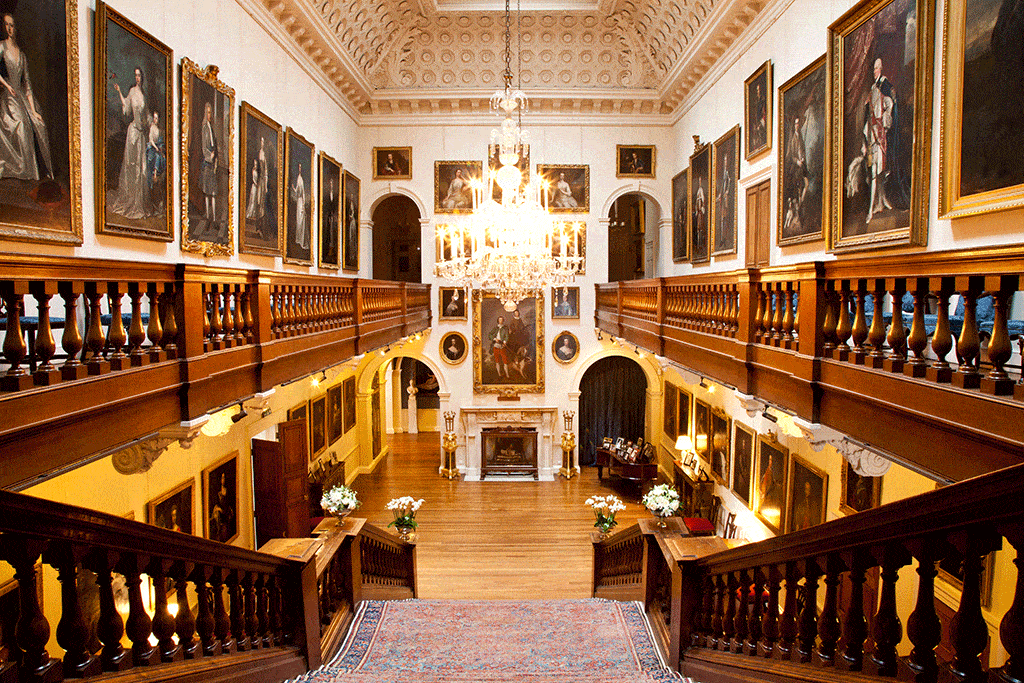
The striking Palladian hall you first enter in-corporates a series of country scenes by the English artist John Wootton - which lends the hall its name. Wootton's fame rests as the specialist English sporting painter of his day. Among other commissions, he executed similar designs for the Great Hall at Longleat. He would not have painted in situ, but in a studio in London, having taken measurements of the spaces that needed to be filled. They were painted as part of the scheme ordered by the Fifth Earl of Sunderland, who, like his brother and heir at Althorp, was a passionate fox-hunter. The life-size studies of the Earl's favourite mounts face the visitor on entering. The canvases running the length of the sides, show Lord Spencer and his friends riding with the Althorp and Pytchley hounds with the riders individually identified. The ruins of nearby Holdenby Castle, the core of which still survives today, further identify the scenes. The details of the hall's construction are not fully recorded, but it is probably by Colin Campbell, though he died in 1729 before the work was undertaken. Roger Morris completed the commission in 1733. For many tastes the hall's proportions make it the most satisfying room in the house, with a cool dignity, appropriately lit. Pevsner calls it 'the noblest Georgian room in the county'. The airiness comes from the high ceiling which rises almost to the height of the house. Its deeply coffered coving bears an octagonal design, with eagles on the corner buttresses. Beneath there is a frieze alternating plaster fox heads with hounds.

Sculpture

  • Standing on plinths about the room are busts of various statesmen, Pitt, Grenville, and Rockingham are by the pre-eminent sculptor of his day, Joseph Nollek-ens. The busts were bought at various times by the Second Earl, from 1795 onwards. Pitt's likeness was modelled from a death mask in 1809 - he never consented to sit during his lifetime. A contemporary Whig joke placed the busts of Pitt looking at Fox, while Fox looked out of the window.
Exhibition, Historic Homes, History Holidays in England, Spencer Family
  • A pair of Italian black and Breschia marble Blackamore torchères, formerly belonging to the First Duke of Marlborough, stand by the entrance. The torsos are Roman taken from the River Tiber with later additions - probably sixteenth-century - of heads, arms and legs. They were included in Vardy's design for the Palm Room at Spencer House, but proved too large to fit in the niches.
Opening Times, Tourist Attractions, Hospitality, Corporate Events, Christmas Festivals
Book Tickets, historic homes, castles, corporate events
Group Visits, Tourist Attractions, Hospitality, Corporate Events, Christmas Festivals
Tourist Attractions, Hospitality, Corporate Events, Christmas Festivals
England History, Historic Homes, Castles, Corporate Events, Festivals
Home | Visiting | House | Events | Shopping | Hospitality | Estate | Spencer Family | Contact | Bookings